“it’s not practice, it’s REHEARSAL”

There’s a new Trevor Schmidt play, How Patty & Joanne Won High Gold at the Grand Christmas Cup Winter Dance Competition. It’s opening simultaneously at Northern Light Theatre in Edmonton, directed by Schmidt, and at Lunchbox Theatre in Calgary, directed by Bronwyn Steinberg.

I saw the Northern Light production. And it left me a little teary, in a contented, some-things-right-in-the-world way.

Jenny McKillop and Kendra Connor play Patty and Joanne, two students in an Adult Beginner Tap class at the Free Body Dance Station. You will probably recognize both performers from amusing shows with Teatro Live! or Fringe or other local companies, but they’re both new to Northern Light. And they have really great chemistry together – both characters mean well, but they start off awkward, not understanding each other and not comfortable together.

As the play starts, they’ve just gotten the message that their dance teacher, Miss Amber, won’t be back to keep teaching them. And the class, which started out full, has dwindled until – are they the only ones who still want to dance? they aren’t sure. Joanne and Patty take turns narrating the story to the audience and interacting with each other in the studio. Rae McCallum’s lighting design makes it clear to us when there’s a shift. The simple set design (Schmidt) makes clever use of the dance mirrors usually hidden behind curtains in the Fringe Studio Theatre.

Both women are middle-aged and have comfortable-enough secure lives, but we see that each of them is lonely and left out, wanting something more, something just for herself. Patty describes coming home from class to see her husband (Peter) and five children (Parker, Patrick, Petra, Poppy, and Emma) decorating cookies together in the kitchen, and they all run to greet her as she drops her dance bag by the kitchen door – and then immediately disperse to other parts of the house leaving her to do all the dishes. I found that bit one of the most poignant things Schmidt has ever written. And the measurement-for-costumes business was hilarious and relatable.

Joanne talks about how she came to love music and dance and especially musical theatre and movie musicals, with memories of being taken on a special movie outing with her parents, wearing a dark red velvet dress with white lace just like her mother’s. “She was beautiful. And on that day, I was a little bit beautiful.” Throughout the play, Joanne bombards Patty with musical theatre history facts and cultural tidbits. She corrects Patty, a sports parent, saying that for dance “it’s not practice, it’s rehearsal”. Their rehearsal outfits are consistent with their different backgrounds/expectations (costumes by Logan Stefura). Joanne is wearing a ballet-pink leotard and tights under a wrap skirt and cut-off CATS t-shirt, while Patty’s outfit includes cutoff grey sweatpants and a football jersey.

In the first scene they rehearse the tap routine that Miss Amber had been teaching them, to “All the Single Ladies”. (Apparently the women in the class would have been dressed as reindeer, with the man as Santa.) The moves are familiar to anyone who’s watched beginner tap classes. They aren’t very good. They keep running that routine periodically as the story progresses, and they get more in sync. Then they change to a piece better suited to entering “musical theatre duet” instead of the “adult group tap” competition class – Mariah Carey’s “All I Want for Christmas is You”. Their performance gradually improves, and their homemade costumes are both credible and fairytale-delightful. Jason Hardwick’s choreography works well to make the easy moves look hard and then have the dancers gradually master them. The soundscape (Lindsay Walker) evokes tap-dance performances and pop-music fun, right from the pre-show selections.

Like many of Trevor Schmidt’s scripts, I started out amused and then became engaged with the likeable but very distinct characters and their situation, realizing afterwards in conversation with my theatregoing companions that there were also some profound messages in the narrative. About the difficulty and awkwardness and necessity of making new friends in mid-life. About wanting “something just for me.” About how anything worth doing is worth doing badly. All of which are good reminders, especially before Christmas.

Running time is about an hour, with no intermission – which is just right for this quiet delightful two-hander.

Tickets to How Patty and Joanne Won High Gold at the Grand Christmas Cup Winter Dance Competition are available here. Performances run until Saturday December 13th. If you’re in Calgary, or if you loved this script so much that you want to road trip, the Lunchbox Theatre production runs at the Vertigo Theatre in Calgary until December 18th.

Guys and Dolls – a fun production of a famous show!

Gambling scene in Guys and Dolls, with Big Jule (Connor Foy) in the centre. Photo Nanc Price Photography.

“It’s the oldest established permanent floating crap game in New York”, goes the oxymoronic Frank Loesser lyric from Guys and Dolls, building the context for a world of drifters and grifters and permanently-floating characters in a New York City neighbourhood, probably in the 1920s. I had never seen this musical before, or done any homework, so I appreciated the context!

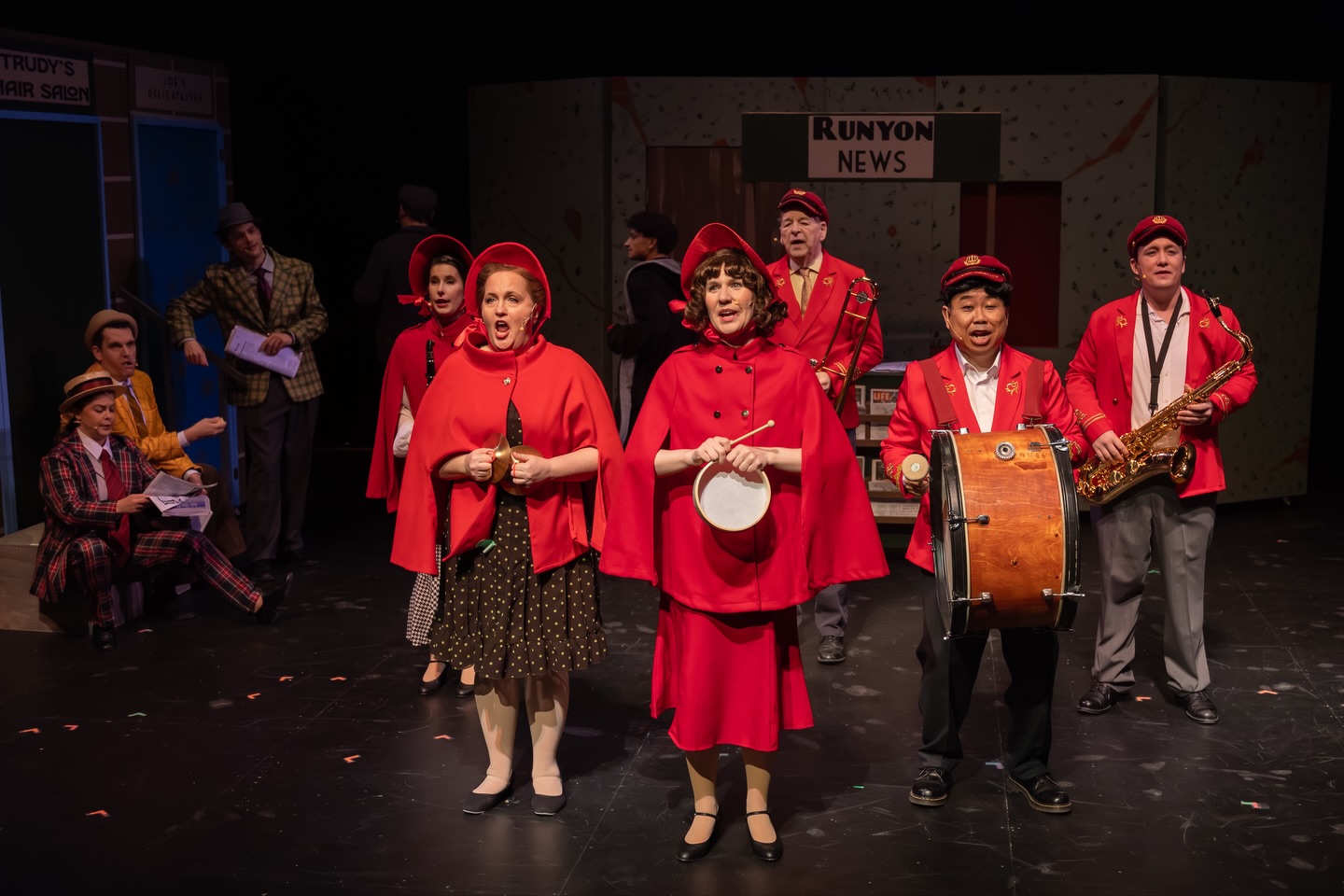
In the current production by Foote in the Door Theatre, directed by Joyanne Rudiak at Théâtre Servus Credit Union, the action opens on a lively urban streetscape (Leland Stelck design) with various characters going about their business. We see a boxer and his trainer, some teenage fangirls chasing any possible celebrity, couples and friends, a police detective, drunk men and women, and a Salvation-Army-like uniformed mission parade, with musical instruments. As in Lin-Manuel Miranda’s In the Heights, the early scenes created a busy and interesting locality – but unlike the Washington Heights neighbourhood of Dominican-American families, the Broadway setting of Guys and Dolls isn’t about families at all.

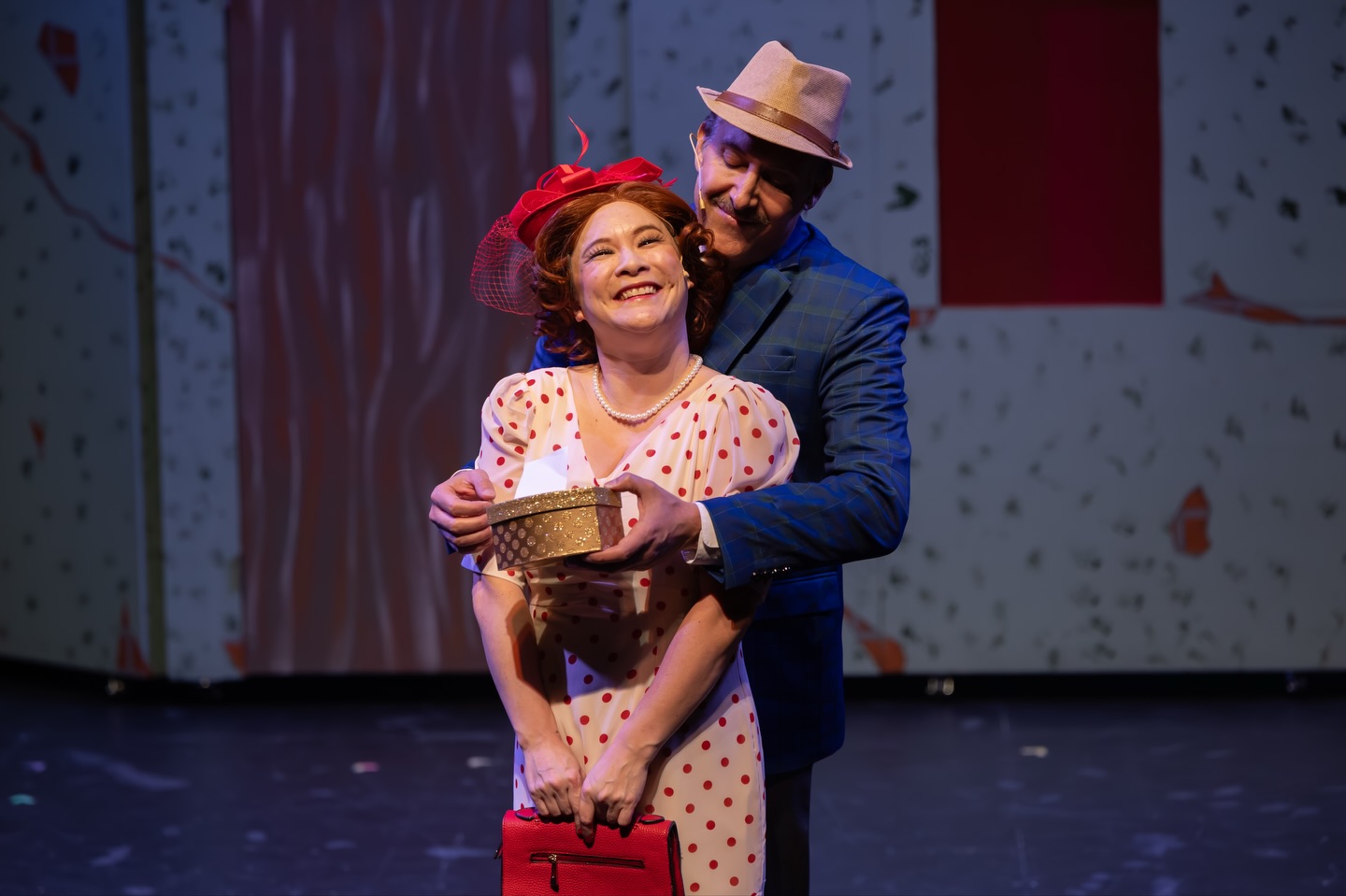
We meet a group of gamblers (Aaron Schaan, Brad Corcoran, Madison Lalonde) and then we meet Nathan Detroit (Russ Farmer), the host of the aforementioned crap game. The presence of a trenchcoated detective (Erwin Veugelers) makes it very clear to the audience that gambling is illegal. Nathan’s longtime fiancée Miss Adelaide (Ruth Wong-Miller) is the star dancer in a nightclub nearby. But he explains to his associates that he doesn’t want to get married, while she sings her frustration with waiting for him and waiting to have a married life with children in the suburbs. “Adelaide’s Lament” is a hilarious song, of the genre where I kept trying to guess the next ridiculous rhyme. I was reminded of some lines in How to Succeed in Business Without Really Trying (also a Loesser/Swerling/Burrows creation), where Wong-Miller’s office-worker character Rosemary dreams of moving to New Rochelle (a Connecticut bedroom town).

Ruth Wong-Miller (Miss Adelaide) and Russ Farmer (Nathan Detroit) in Guys and Dolls. Photo Nanc Price Photography.

A delightful contrast to this cast of ne’er-do-wells and nightlife is the presence of a mission outpost. They’re clearly a Salvation Army tribute, with red uniforms, pseudo military ranks, and a marching band (made up of Brian Ault on trombone, Eilidh Tew on clarinet, one saxophonist I didn’t recognize, and several enthusiastic percussionists). Sergeant Sarah (Kit Kroeker) seems to be in charge, but also an upperclass misfit in the rough Broadway area. Kroeker’s voice is well suited to the mix of hymn-singing, trained solo belt, and duets in her role – a pleasing contrast with Wong-Miller’s character’s nasal dialect and less forceful voice. (I’ve heard Wong-Miller sing in enough other shows that I know it was the character, not the singer!) There were opportunities for jokes about well-meaning clueless missionaries, which landed just as well in 2025.

Sergeant Sarah (Kit Kroeker) and the Save a Soul Mission band, in Guys and Dolls. Photo Nanc Price Photography.

Like many traditional musicals, the story needs two couples with obstacles to romance, as well as a main plot objective (Nathan finding a new venue for his craps game). Nathan and Adelaide are one at-odds couple (see what I did there?) Sergeant Sarah is thrown together with high-stakes gambler Sky Masterson (Aidan Heaman), who tries to take her out on a bet, but then falls for her (of course!)

Some of the most fun scenes in this show are the large cast choreography filling up the big stage at Theatre Servus (Adam Kuss). I was sitting in the front row so I felt immersed (although never quite endangered) – sitting further back would probably let you appreciate the full scope of the action though! My favourite was the action at the plaza in Havana, where colourful salsa performers and restaurant customers danced joyfully and flirted and fought, while ASMs doubled as bar staff to crowd the plaza even more. Although the simulated dice-games in the sewer for “The Crapshooters’ Dance” were also great, with about 20 male-identifying characters incorporated in the action – Connor Foy and Aaron Schaan as featured dancers, and versatile ensemble members like Julia Stanski and Chelsea Makwae and Eilidh Tew just as captivating in trouser roles as in chorus-girl or “doll” roles.

Aidan Heaman, Sky Masterson, then glows in his spotlight with the classic “Luck be a Lady Tonight!”

I won’t give away the rest of the plot – suffice it to say that there are no big surprises. It turns out that for a show I didn’t know, a lot of it was already familiar songs and tropes, so it was fun to recognize them as they came up. It was also satisfying for me to recognize faces and names as people I’d worked with before, at Walterdale, for ELOPE, and for Foote in the Door. At least two of them have supported Walterdale productions in backstage roles, and maybe 10 of them onstage, and one playwright, for example.

Guys and Dolls continues at Théâtre Servus Credit Union (La Cité Francophone) until November 30th, with tickets available here. As well as a snacks-and-drinks concession, they are also selling Peace by Chocolate chocolate bars in show-themed sleeves. The chocolate is so good that I might go back tonight just to buy more!

The 39 Steps – a new Teatro classic!

Priya Narine as Annabella Schmidt and Geoffrey Simon Brown as Richard Hannay, in The 39 Steps.

Photo Marc Chalifoux, costumes Brian Bast, set Chantel Fortin, lighting Rory Turner

The first play in the new Teatro Live! season, Farren Timoteo’s first as artistic director, is the hilarious, fast-moving, and farfetched The 39 Steps.

The 39 Steps was first a 1915 adventure novel / melodramatic thriller by John Buchan, who later served as the 15th Governor-General of Canada. I read the novel as a teenager, along with Buchan’s other works Greenmantle and Prester John, because my father had kept his childhood copies. It was adapted into a spy-thriller movie by Alfred Hitchcock in 1935, and had a few later film adaptations as well. In 2005, Patrick Barlow wrote this stage-play based on the earlier versions, but dialing everything up to the point of parody for 21st-century audiences.

The curtains open on emo-self-absorbed Richard Hannay, slouching in an armchair in his half-unpacked London flat, explaining that all his friends have moved away or died and he is bored. In this production Hannay is played by Geoffrey Simon Brown, who brings an amusing mix of bravado and bewilderment to the role.

Fortunately for the audience, his state of ennui doesn’t last long! A trip to the (vaudeville) theatre brings him an encounter with a mysterious woman (Priya Narine), who demands sanctuary in his apartment but ends up being murdered after entrusting him with vague secrets and missions.

Many many minor characters in the story of Hannay’s flight across England and Scotland are portrayed by two ensemble members (billed as Clown 1 and Clown 2), Michael Watt and Katie Yoner. Watt and Yoner are both noted physical-comedy performers in their own work as well as BFA-educated actors, and they were perfect for these roles, in which the quick-changes are acknowledged and sometimes flawed. Edmonton audiences rarely applaud transitions, but there was one shift that had Yoner’s character grabbing the four chairs and a table that had been representing a vehicle, and striking all of them in one trip, ending with crashing and banging in the wings.

Michael Watt, Katie Yoner, and Geoffrey Simon Brown in The 39 Steps. Lighting Rory Turner, Costumes, Brian Bast, Set Chantel Fortin. Photos Marc Chalifoux Photography.

Narine also portrays some other characters encountered by Hannay – an indignant rail passenger who reports him to the police, a lonely young Scottish crofter – sending up various tropes of women in early-20th-century thrillers.

I recalled a previous production of 39 Steps that I saw in the intimate space of Walterdale Theatre in 2022, where I kept swivelling my head back and forth to follow the fast-paced action of a train across the Forth Rail Bridge, a manhunt by air, a flight across misty sheep-pasture, and a final showdown back in a London theatre. I wondered how Timoteo’s direction in the larger traditional proscenium-stage auditorium would evoke the urgency and immersive nature of the script. And I was pleasantly surprised! Some of the action had me gasping and laughing because even with my vague memories of the story I hadn’t predicted what was going to happen next and how.

Design choices for this production all supported the action which was central to the play. Many set pieces (Chantel Fortin) were used in different creative ways. Lighting (Rory Turner), fog, sound, and Brian Bast’s costuming added atmosphere and affirmed the familiar tropes.

I found some of the dialogue hard to hear or understand, particularly when they were speaking quickly in unfamiliar accents over background sounds of trains or gunshots. But it wasn’t hard to follow. The plot was both farfetched and satisfying, and it was a great night out.

The 39 Steps is playing at the Varscona Theatre until November 30th, with tickets available here and at the door.

Next on my theatregoing calendar are two shows next weekend:

Guys and Dolls, the Loesser/Swerling/Burrows 1950 musical, a Foote in the Door production at La Cité Francophone / Théâtre Servus Credit Union, running Nov 21-Nov 30. Tickets here!

PepperMUNT, the bi-munt-ly late cabaret, will be on Saturday November 22nd, this time in the Old Strathcona Farmers’ Market. Tickets here!

Fall 2025 Quick Takes

What I’ve been watching, and haven’t made time to post about:

Nicole Moeller’s WILDCAT at Workshop West Playwrights’ Theatre. The best thing about this play is the performers – Michelle Flieger and Maralyn Ryan as women a bit older than me, remembering their labour-activist past and frustrated in an increasingly-constrained present, Melissa Thingelstad as a lawyer daughter who works hard on taking care of her mum and not quite so much on figuring out what her mum wants, and Graham Mothersill as … well, as I said to a friend afterwards, Graham Mothersill pretty much has a lock on playing “nasty. ” Interesting and disturbing timely premise, with some points tweaked for the 2025 Alberta situation. I found the soundscape a bit intrusive, but that might be better for audience sitting further from the booth/back speakers. Heather Inglis directs. After a delayed start, WILDCAT‘s short run has two more shows, today (Saturday) matinee and evening, and tomorrow (Sunday Nov 9) matinee. Workshop West tickets and subscriptions continue to be 100% Pay what you will, online and in person.

25th Annual Putnam County Spelling Bee, part of the MacEwan University Music Theatre season and directed by Ellen Chorley. Like all the MacEwan shows, this one had a short run last weekend, and it sold out the Tim Ryan Theatre Lab space every night. It’s a good choice for a student show, with most of the young-adult performers playing children and a few playing adults (parents and competition staff). The set design was playful and functional, with an evocative representation of an American school gym, worn basketball-marked hardwood floor to wooden climbing frame, swinging doors full of photocopied notices, and old-school wall phone with the longest most mangled cord ever. Choreography was fun and energetic. Jack Hunting (Olive Ostrosky) and Kohen Foley (Leaf Coneybear) were particularly memorable as characters. In 2013 I saw a production of this musical by local company ELOPE. I’m a little embarrassed that I wrote in this blog at the time that I didn’t recognize the actor names, because now they’re all performers whose names would make me choose to go see something they’re in. MacEwan’s next show is Carrie: The Musical. It’s in the bigger Triffo Theatre space so some seats are still available, for Nov 26-30.

According to the Chorus was Walterdale Theatre’s October show. The Arlene Hutton script was directed by Barbara Mah, and set in the crowded female-chorus quick-change room of a Broadway theatre in the 1980s. Costumes – both the over-the-top concepts the dancers wear to perform, and the flamboyant neon warmup gear they arrive in – were splendid and funny and appropriately period, thanks to costume designer Karin Lauderdale. Walterdale’s next show is Noël Coward’s Present Laughter, directed by John Anderson, December 3-13. The talented cast includes Randy Brososky, the multi-talented actor/creator/improviser/director, along with 10 other performers, some new to Walterdale and some familiar. Advance tickets are here.

Die-Nasty is Edmonton’s long-running very-long-form improvised soap opera, this year tackling The Bible. Or rather, stories from those settings which didn’t make it into the versions we know, either the Torah or the New Testament. Die-Nasty’s company and guest performers create characters and the director (Jake Tkaczyk) gives them bare-bones scene descriptions to fill in on a moment’s notice. And somehow this turns into fascinating character development, plot points which could be excessive or nuanced or both, and moments of hilarity that are hard to describe afterwards. Last year they built a gold-rush town, complete with saloons and schoolmistress, doctor and explorers and a matriarch of many sons … Company members this year include Little Guitar Boy brothers Jason Hardwick and Lindsay Walker, who bear some resemblance to musical collaborators John&Paul as well as to various disciple origin stories, the aforementioned Randy Brososky who seems particularly suspicious, journalist Myrrh Incense (Kirsten Throndson), and others, and recent special guests have included Matt Baram and Naomi Sniecus (creator-performers of Big Stuff at the Citadel). Paul Morgan Donald provides live music and sometimes the characters sing! You don’t need to follow from the beginning, as they give recaps and character intros at the start of each show. Tickets for Die-Nasty are also 100% Pay What You Will now, at the theatre or online. Varscona Theatre, Monday nights at 7:30.

I don’t know if I’ll be able to fit in everything I want to see in November, but the list includes

Tough Guy, by Hayley Moorhouse, at the Arts Barns, two last shows today Saturday Nov 8th, advance tickets here.

Castle Spectre, an adaptation by Lauren Tamke who directed this production for her Paper Crown Theatre, at Gateway Theatre, Nov 21-30, tickets here.

Beehive the 1960s musical, at St Albert Dinner Theatre, directed by Caitlyn Tywoniuk and music direction by Dalton Terhorst, tickets here.

Teatro Live doing The 39 Steps, with Geoffrey Simon Brown as Richard Hannay, Nov 13-30.

Northern Light Theatre has a new play by Trevor Schmidt, How Patty and Joanne Won High Gold at the Grand Christmas Cup Winter Dance Competition, with Jenny McKillop and Kendra Connor, Nov 27 – Dec 13. Tickets here.

Vinyl Cafe: The Musical, at the Citadel, Nov 8 – Dec 7, tickets here.

A lovely musical about memories: Morningside Road

[Posted without imagery due to web-host issue]

Last night I was able to attend the preview performance of Morningside Road, the musical created by Mhairi Berg and Simon Abbott. It’s the first production of Shadow Theatre’s new season, and it was directed by incoming artistic director Lana Hughes.

I was enchanted. Right from entering the auditorium and seeing the set – I thought to myself, I bet that’s a Daniel van Heyst design, and I was right. The set includes a realistic homey kitchen nook with tea things and a collection of family photos, but also a more abstract area with bits of low stone wall, which becomes various outdoor city locations.

I stayed caught up in the story with three likeable characters, Elaine (contemporary Elaine was played by Maureen Rooney and Elaine of memory was played by Mhairi Berg), the Girl (Elaine’s grand-daughter, Mhairi Berg), and the Lad (Cameron Kneteman). It wasn’t the first “how my grandparents met” play that I’ve seen – Megan and Beth Dart’s Ursa Major was another memorable one – but the story was engaging and the structure worked very well, shifting between now and back-then, between a kitchen in Canada and a city street in Edinburgh. The pacing was appropriate – I never felt like a scene or a song was too long, and I appreciated the various musical callbacks and familiar riffs adding to the continuity. Partway through, I realized that part of what I was admiring was deft lighting design (Liekke den Bakker), with smooth shifts between times/locations/moods and no heavy-handed dimming of areas I was looking at. Costuming (Kat Evans) was that kind of deceptively-simple that perfectly suited the characters and setting but didn’t distract. Of course practical-grandmother Elaine would be wearing slacks and long cardigans and the same comfortable shoes that my own mother wore for years, rather than more old-fashioned housedresses and aprons, and the other performers wore vaguely-timeless outfits that weren’t out of place in 1940s Edinburgh or in the more modern scenes.

The live musical ensemble of Simon Abbott, Curtis den Otter, and Viktoria Grynenko is located upstage centre behind a screen, which worked very well for sound balance and also allowed for the actors to include them in some scenes more actively. One of the songs, That Blessèd Wedding Day, was a lively catchy community-storytelling piece with dancing, in a folk-song idiom like Great Big Sea.

Rooney’s Elaine has clearly been telling stories about her life to her granddaughter for many years. The two of them are allies, more strongly connected than the offstage daughter/mother in between. I was reminded of my own late (great-)Aunt Elaine, who came to Canada from Scotland as a war bride and remained a daily crossword-puzzle fiend well into her 90s. The motif of one person’s story becoming common property, so that the younger generation might object or correct when the grandparent tries telling the story differently (“that’s not right!”) was also familiar and fascinating. Suggestions of Elaine beginning to lose her memory / memories and executive functioning were also done with a light touch.

The music was lovely and it contributed to the storytelling and the character portrayals. I had not heard Rooney sing before, but I was very impressed.

I wasn’t able to see the version of this musical that Berg and Abbott presented at last year’s Fringe festival, so I can’t tell you how the Shadow Theatre production differs. But I was very pleased with this one – it is nuanced, affectionate, and wistful.

Running time is a bit under 2 hours – and just the length it needs to be. Tickets are available here, for the run continuing until November 6th.

Northern Light’s The Pink Unicorn: hopeful and loving

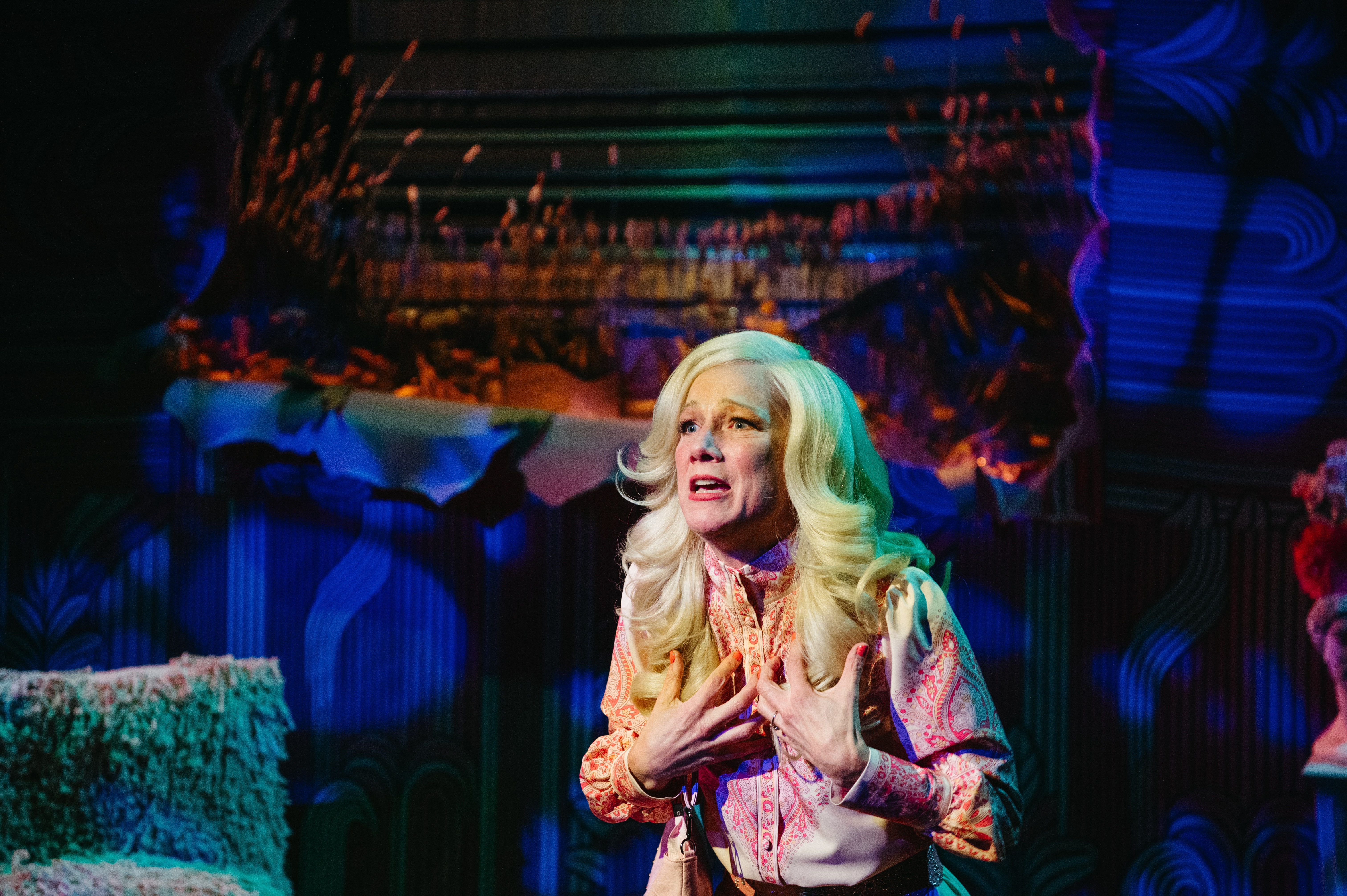
Patricia Zentilli as Trisha Lee in The Pink Unicorn. Images Brianne Jang BB Photographic. Set and costume Trevor Schmidt, lighting Larissa Poho.

The first production in Northern Light Theatre’s 50th-anniversary season is The Pink Unicorn, by Elise Forier Edie, directed and designed by Trevor Schmidt. I meant to tell you about it last week, but for some reason my blog host wasn’t letting me post pictures. So I waited, since I love the promo photos of Trisha telling her story.

And it’s so good! Patricia Zentilli plays small-town Texas mom Trisha Lee. Trisha’s been raising her only child Jolene alone since her husband Earl died when Jolene was six. Various details show that she’s always been proud of her daughter and supported her in being her unique creative self. So when Jolene tells her mom that she’s going to start high school as an agender and pansexual person, named Jo, Trisha responds as well as she can manage – helping to shop for a leather jacket, and looking up the unfamiliar terms on the internet at work. She worries a bit about whether the other kids will mistreat Jo, but reassures herself and the audience that Jo looks “real cute” in her buzzed hair and black boots. By this point I realize that it’s not just me – that the whole audience is clearly on Trisha’s side here. We might feel superior from our 2025 perspective, already knowing the vocabulary – but Trisha Lee is so easy to relate to, a loving parent trying to support and protect her kid, who’s living a life Trisha doesn’t understand.

You might remember that Northern Light produced this solo play in 2015, with Louise Lambert performing, and with Trevor Schmidt directing and designing. I think the current production brings us a more nuanced portrayal of Trisha. I was struck by her bravery, in the way she did uncomfortable things because she needed to – from her history of getting a job and carrying on as a single parent after her husband died, to her steps into activism on Jo’s behalf.

Trisha also tells the audience parts of the story that don’t reflect well on her, acknowledging that some of the thoughts are things you aren’t supposed to say. But the comments she makes without apologizing help to remind the audience that she’s still part of that particular culture, where “Latino, Hispanic, and Chicano” are all still used, and in the inner monologue we’re privy to, she always refers to Jo as “she”, not as Jo’s requested pronoun of “they”. That particular point reminded me that maybe I’m making judgements based on superficialities too. Trisha is doing so much to support her daughter and the rest of the unofficial GSA, why do I even notice the pronouns detail?

Patricia Zentilli as Trisha Lee in The Pink Unicorn. Images Brianne Jang BB Photographic. Set and costume Trevor Schmidt, lighting Larissa Poho.

The set design (Schmidt) creates the sense of a feminine living-room – even a jug of pink lemonade on the coffee table – in front of a fascinating background with dainty pink wallpaper torn open to reveal a sculptured rural landscape. Lighting (Larissa Poho) and sound (Darrin Hagen) enhance the shifts in storytelling tone and location, through a church service, a downmarket bar, and a protest in the rain. Trisha’s outfit includes boots and a silver-medallions belt over a pink patterned dress and large hair, but it feels contextual rather than caricaturistic (I’m doing a rewatch of the small-town-Texas TV show Friday Night Lights, and she’d fit in there if she wanted to).

Also – parts of it are hilarious! Zentilli is great at delivering funny lines that the character doesn’t see as funny, or doesn’t stop to enjoy. This is no surprise to anyone who’s seen her in various big-stage musicals at the Citadel or the Mayfield,

The Pink Unicorn is both provocative and hopeful. In the author interview in the show program, Forier Edie says that if she were writing it today, she might write a “scarier” version. But I loved the reminder that people’s minds can be changed, one at a time, by really listening to the people they care about. And I appreciated the call-to-action at the end, where Trisha points out to us that doing the hard thing isn’t just for people who are already good at it. I know there are lots of Jos around here, and lots of Elijah Breakenridges. And I know that not all of them have a Trisha in their corner. But Trisha’s story shows that you don’t have to be an experienced advocate to start doing the right thing for someone you care about – just do it.

The Pink Unicorn is playing at the ATB Arts Barns Studio Theatre until October 11th. Tickets are here.

Amélie: whimsical and fun!

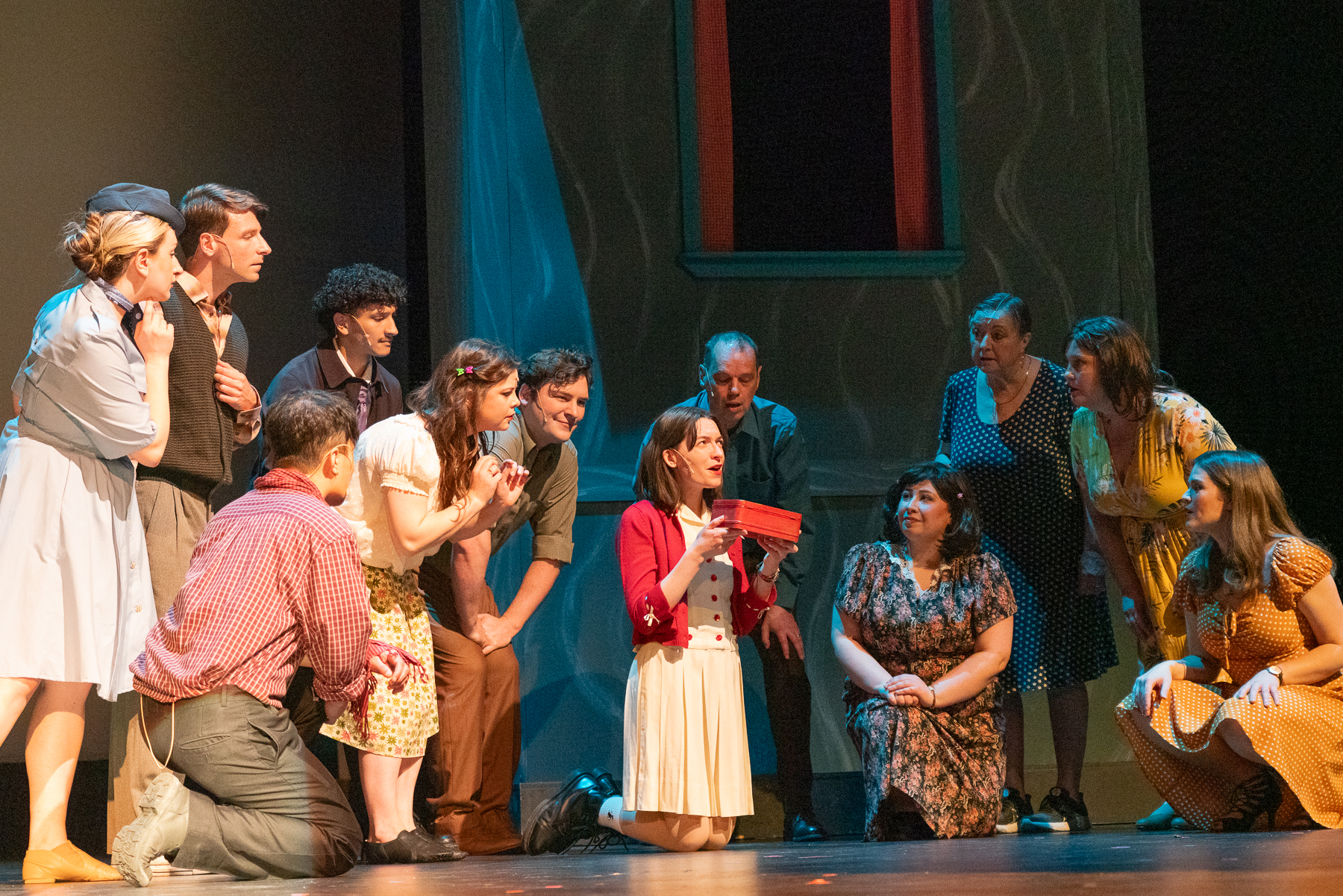
Actor on her knees holding an old red metal box, surrounded by other actors.
Lauren Upshall-Ripley, as Amelie, holds a treasure box, surrounded by friends and neighbours. Photo Kara Little.

ELOPE, the long-running local musical-theatre company, is currently performing Amelie, the musical, at the University of Alberta Timms Centre. It is quirky, delightful, and unexpected – and very well done.

Amélie, the musical (music by Daniel Messé, lyrics by Messé and Nathan Tysen and a book by Craig Lucas, is based on the 2001 French movie of the same name. I still haven’t seen the movie, so I kept laughing with surprise as the narrative unfolded.

Lauren Upshall-Ripley is perfectly cast as Amélie, the title character, a young woman whose background as an isolated child equips her with playful daydreams and fantasies. And Danika Reinhart plays 6-year-old Young Amélie, illustrating with painful poignancy how the optimistic child’s resilience shines past her fearful and repressive parents (Erwin Veugelers and Rachel Frey). The duets between Upshall-Ripley and Reinhart were particularly strong, with vocal balance and warm connection between the younger self and older self. I was reminded of the Netflix series Unbreakable Kimmy Schmidt, which also portrayed a likeable and resilient young woman in modern New York, with humour and without sentimentality.

Actor in red cardigan and simple white dress stands joyfully with outstretched arms.
Lauren Upshall-Ripley, as Amelie. Photo by Kara Little.

One quirk of the script was the way that many of the ensemble members in the 19-person cast took turns narrating the key points of Amélie’s life to the audience, with wry humour and a strong sense of community. The scenes illustrate a lively neighbourhood of Montmartre, centred around the Two Windmills Cafe, where Amélie works. Her co-workers Gina (Christy Climenhaga) and Georgette (Josephine Herbut), employer Suzanne (Judy McFerran Stelck), and other neighbours all have their own challenges and heartbreaks, but like the best workplace comedies, they’re all engaged in trying to help each other. Director Kristen Finlay has a resume full of productions where each member of a large cast has clear interesting intentions and also blends as an ensemble – 25th Annual Putnam County Spelling Bee for ELOPE, Penelopiad, Chess, The 39 Steps for Walterdale, and others.

The narrators give specific dates – of Amélie’s conception, of her mother’s death, of her move to Paris, of a day her life changed – this let me figure out how old she was at each point, but also turned out to be a clue that key events for Amélie were affected by Princess Diana’s visit to Paris and untimely death. Amélie watches television coverage of Diana’s funeral, alone in her apartment, and daydreams of being honoured like Diana. Connor Foy plays Elton John, singing “Goodbye, Amélie” at a white-lacquered grand piano and leading a sequined ensemble – the audience was screaming as the first act ended.

Amelie’s adventures involve various other neighbours and friends, but weaving through these stories we see hints of another quirky and creative outsider, Nino, played by Colin Stewart. “Who are you?” asks Nino, on the phone with Amelie. “I’m a mystery wrapped in an enigma trapped in a paradox disappearing into thin air. ” “Me too.” Will they meet up? Will it be worth it? Will it work out? We want it to.

Actor in leather jacket and cross-body satchel sings joyfully.
Colin Stewart as Nino Quincampois, in Amelie. Photo by Kara Little.

In another vignette, Amélie returns some childhood treasures to a lonely man (Dustin Berube). Berube and Upshall-Ripley’s duet, “How to Tell Time”, was one of my favourite moments.

Musical direction was provided by Sally Hunt, with eight other musicians. David Son created choreography for the ensemble that was both exciting and well-executed, and also joined the ensemble himself in a few small roles, including (hilariously) an escaping Goldfish. Debo Gunning designed costumes that supported each character, from Amélie’s artless awkwardness in shirtwaist and Doc Martens, to the more sophisticated Parisian women of the cafe and sex shop, and Elton John fabulously excessive with feathery epaulettes to his sequined jacket. The facilities and technical capabilities of the Timms Centre Main Stage were effectively used by ELOPE’s technical team (set design credit to Leland Stelck). Finlay and Son’s blocking and movement of the large cast on the deep stage never felt crowded.

Amélie is playing at the Timms Centre until Saturday July 5th. Get your tickets here.

The 50th season of Northern Light!

Northern Light Theatre announces their 50th-anniversary season!

Next year will be the 50th season of Northern Light Theatre, an independent company whose mandate includes bringing challenging, thought-provoking, unfamiliar, and entertaining work to Edmonton audiences, with particular attention to stories of women. Artistic Director Trevor Schmidt has a particular gift for play selection, so that a Northern Light season typically includes at least one playwright I’d never heard of, but whose work captivates me and might be relatable or disturbing or both. Schmidt is also a playwright himself, with ventures into the poignant, the macabre, and the screamingly funny.

Last year’s NLT season was themed “Making a Monster”. Schmidt’s own Monstress started the season with a disturbing gothic Frankenstein-esque tale that left me thinking I wasn’t sure who the monster was. Angry Alan, by Penelope Skinner, starred Cody Porter as an ordinary guy who gets sucked in by “men’s-rights” rhetoric, with horrible consequences. And Philip Ridley’s Radiant Vermin showed a different kind of monstrousness, but was hilarious at the same time. It was one of the most thematically-effective seasons I’ve ever seen.

This coming year is called “The F Word”, as a play on the age of fifty being unspeakable. And the three plays each have some call-back to aspects of Northern Light’s history. The first one is a remount of the award winning The Pink Unicorn, by Elise Forier Edie, which was an award-winner in the 2014-2015 season. Trevor Schmidt told me that this production will use an updated version of the script, which is shorter and more cohesive. Patricia Zentilli will play Trisha, and Schmidt promises an all-new design, with a twinkle in his eye. If you’re not familiar with The Pink Unicorn, it’s the solo narrative of Trisha, a small-town Texas woman whose daughter begins to identify as agender, genderqueer and pansexual. Trisha loves her daughter, but struggles with her community’s intolerance, in a fight she didn’t choose. In 2015, I thought it was topical and ahead of its time — in 2025, I imagine I will find it even more topical, and definitely not dated!

Before Christmas is another Trevor Schmidt original, How Patty and Joanne Won High Gold At The Grand Christmas Cup Winter Dance Competition. The excerpts read at the season-launch included Jenny McKillop as a frazzled mum looking for an activity of her own, and Leona Brausen reading as another middle-aged-tap-dancer character. It seems like it will be very funny, but also an effective reminder of community and of loneliness.

The exploration of loneliness will come to the fore in the last play of the season, Franz Xaver Kroetz’s Request Programme. Instead of presenting an excerpt from this play, the teaser given at the season-launch was a performance by singer-songwriter-guitarist Cayley Thomas (a U of A BFA Acting grad), a wistful and moving song about missing her late brother. Schmidt explained that for each performance of this play, one actor from NLT’s long roster of talented female-presenting performers will perform a character’s solitary life routine without dialogue, while a soundtrack of a radio “request programme” plays in the background. The music on the request programmme will all be from local female artists, including Cayley Thomas. Some of the actors have already been identified – Linda Grass, Holly Turner, Nadien Chu, Michelle Todd, Pat Darbasie, Sylvia Wong, Davina Stewart, Kristin Johnston, Cheryl Jameson, Melissa Thingelstad – and with a few more still to be confirmed.

Early in 2026, the NLT Board will also be hosting some kind of gala 50th-anniversary celebration, details to follow. But the F-Word season seems commemorative and celebratory enough in itself. VIP season subscriptions are currently available here at an early-bird price until July 2nd.

Amadeus – according to Salieri

Amadeus, by Peter Shaffer, was a play (1979) before it was a movie (1985 Best Picture Oscar).

The play, in the Psychopomp Theatre production directed by Jon Shields, starts with an angelic choir singing in opera style, surrounding a very old man huddled in a wheelchair and containing a hand tremor. He is composer Antonio Salieri (Randy Brososky), the narrator and the central character in the play, despite it being named for Mozart.

Salieri rises from his chair with difficulty and calls for house lights to see the audience he is addressing. He seems to be endowing us with powers of extra-human witnessing or perhaps divine judgement – are we the choir of angels? – as he promises to tell us the story of what he did to Mozart long ago and how he’s paying for it. He speaks to us in English, but he also speaks to God in what appears to be fluent Italian.

The scene shifts – Salieri morphs to an active 30 year old – and this is when he first meets his rival, the younger composer and former child prodigy Mozart. Salieri tells us that he wanted so badly to be famous for his music that he had made bargains with God. He had the position of Court Composer to Emperor Joseph (John Evans) in Vienna. He shows the audience his servants and his “venticelli” or gentle winds, flamboyant gossips he engages to bring him the latest rumours (Andrew Mecready and Randall MacDonald). The venticelli tell him that young Mozart is coming to court, so he arranges to eavesdrop and then to be introduced. But to Salieri’s disgust, in person Wolfgang Mozart (Drake Seipert) is vulgar and annoying and self-centred. Seipert portrays Mozart with the most irritating laugh ever.

Salieri is astonished and resentful that someone so vulgar can have the gifts of music and fame that he longs for himself. The quid-pro-quo that seems to be central to his relationship with the Divine launches him into resentment and the most disturbing portrayal of artistic jealousy that I have ever seen.

Brososky’s portrayal of Salieri is brilliant. His bitterness poisons his own nature as he goes further and further in trying to harm Mozart. Mozart’s wife Constanze Weber-Mozart (Cassie Hymen) tries to protect her husband and is also affected by Salieri’s schemes.

A cast of 14 plays many ensemble roles, nobles and servants and citizens. I was fascinated to encounter references to several of Mozart’s operas I recognized, including Magic Flute, Don Giovanni, and Marriage of Figaro. Costuming (Nancy Skorobohach) conveys the excesses of the period and provides clues to class and character.

I was also fascinated to see allusions to Mozart’s character traits which I had first learned of in Erin Hutchison’s Fringe musical Regression last summer – in particular his persistent scatological humour. I’d already encountered a portrayal of Van Gogh on the Shadow Theatre stage this winter, consistent with Hutchison’s characterization, so it amuses me that the third avatar of art in the musical Regression, Willliam Shakespeare, will be on stage in Shakespeare in Love at Walterdale Theatre this summer.

Amadeus has a short run (May 8-15 only) in the auditorium at Campus St-Jean, with tickets available here. The main entrance to the building is under construction, but there is labelled access through the main entrance to an elevator.

The Ballad of Maria Marten – a woman who was more than a victim

Eerie image of Ballad of Maria Marten cast. Photo Kendra Nordstrom

Before attending a preview of the Leduc Drama Society production of Beth Flintoff’s The Ballad of Maria Marten, I didn’t know very much about the play. I did know that it was based on a true story, and I was pretty sure the title character would die.

That’s not much of a spoiler, since very early in the performance the narrator (Emily Rutledge) introduces herself to the audience and explains that she sees things differently now that she’s dead – and it’s a relief. Now that she knows the truth, she knows that none of it was her fault, despite what “he” had been telling her. That was a fascinating viewpoint and I was curious to know more.

The character crumpled at the narrator’s feet turns out to be the younger/alive Maria (Sarah Gibson). And the company then takes us through the story of her life from about age 10 to her murder about 15 years later. I was reminded of other narrative conventions – like the way that After Mourning, Before Van Gogh uses two actors to portray different periods in the protagonist Joanna’s life, or the way that Our Town has the spirit of the dead girl walking through the community while the other characters go about their lives. I was repeatedly reminded of Tess (the Roman Polanski movie, as I’ve never tackled the Thomas Hardy book), because the title character often seemed doomed by her class and gender, penalized unfairly because she was a woman in poverty who dared to seek for survival and hope for love.

However, the playwright Beth Flintoff takes the known facts about Maria Marten’s life and death and shapes them into a compelling narrative of a likeable lively girl/woman with significant agency and female support – from her friendships with other girls (Marisa Scarbeau, Anglia Redding, Bethany Doerksen, Lee-Anna Semenyna) and allying with her new stepmother (Karen Huntley) to finally experience some childhood happiness now that she wasn’t responsible for keeping house. I was struck by the choice not to have her father be an on-stage character in the story – he seemed to be benign, but not relevant to Maria’s life and death the way her stepmother was. I was also impressed at the sex-positive threads woven through the storyline, especially through the character of Sarah (Scarbeau), sharing contraceptive folk-remedies with her friends and proud of her “bastard” children (delightful cameos from Willow Marshall and Cooper Marshall).

Michael Leoppky and Ryan Mattila play Maria’s various partners and the fathers of her children. There was nuance to these portrayals as well, even though none had much stage time.

Knowing that the title character dies, murdered by a man, I spent much of the first act wondering who, and then wondering why. A quick Wikipedia browse tells me that the case has been popular with true-crime fans ever since the original trial. In one of the most unsettling moments of the play, Rutledge’s spirit-of-Maria narrator confronts the audience directly about us coming in hopes of seeing the violent death.

But that’s not the story she chooses to tell/show. We do see the murderer on stage, but never hear him speak. We don’t see Maria’s death. We do see her friends and family struggling with whether and how to testify in the trial, and meeting to enact their own version of justice. There is another plot thread with a much more satisfying ending as well, leaving me with a sense of hope, a reminder that women supporting each other can make a difference, even in cultures of systemic oppression. Maria wasn’t saved, but she was vindicated, and others were saved.

Director Shawn Marshall has created a sensitive portrayal of these 19th-century characters, with glimpses of joy and humour and kindness. Costumes (Cyndi Wagner), props (Kendra Nordstrom) and the simple but haunting set and lights (Len Marshall builder) enhance the mood, hopeful and oppressive by turns.

The Ballad of Maria Marten plays tonight through Saturday night, and Saturday afternoon, at the Maclab Centre for the Performing Arts in Leduc (next to Leduc Composite High School), and then plays for one night at the Manluk Centre in Wetaskiwin on May 30. Tickets for this weekend’s run are available here. It’s disturbing and it’s uplifting, and it’s worth the drive.